 transferoracle.ai
Transfer Oracle
We detect AI failures before they show up in your metrics
All AI systems — vision, language, or multimodal — rely on internal representations. When those degrade, the system becomes unreliable. Transfer Oracle measures that degradation directly — before your model reaches production. One API call. No labels required.
Transfer Oracle is powered by Growt — a general mathematical framework for structural alignment.
21 open-source plugins
Integrates with the ML stack you already use
Open-source plugins drop into your existing pipeline. Each pill links to its GitHub repo.
Every pill links to its repo on github.com/LeeSandberg — MPL-2.0 licensed.
AI systems fail before you can measure it
Models are evaluated on accuracy, loss, perplexity, and benchmark scores. These metrics assume that if outputs look correct, the system is functioning properly. That assumption is false.
- ✗Model compression (quantization)
- ✗Fine-tuning and distillation
- ✗Domain transfer
- ✗Runtime drift
- ✗Silent failures in production
- ✗Undetected hallucinations
- ✗Broken decision boundaries
- ✗Regulatory and safety risks
Structural validation — not just output testing
We analyse the internal state of models — not just their outputs. When internal representations degrade, class boundaries collapse, token relationships destabilise, and decision regions become inconsistent. Standard evaluation does not measure this. Transfer Oracle does.
CNNs, ViTs, object detection, medical imaging
LLMs, fine-tuned adapters, quantised deployments
VLMs, VLAs, cross-modal alignment
Detect failure before it becomes visible
Hidden failure in LLMs
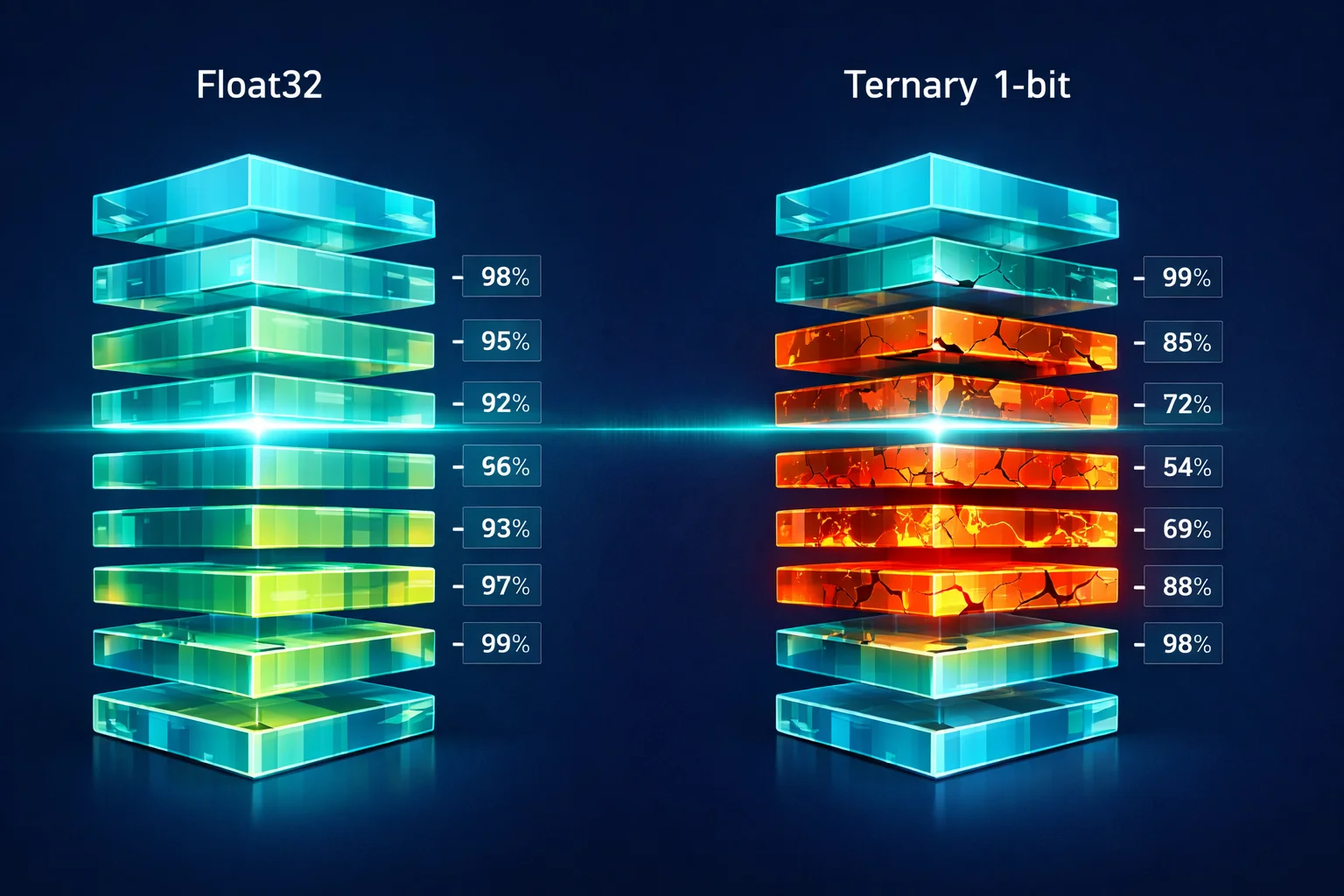
A compressed language model passes all standard benchmarks. Output looks correct. But internally, it's already unstable.
The model appears correct but is already unstable. This leads to hallucinations, inconsistent reasoning, and unsafe outputs in edge cases — invisible to standard benchmarks.
If you only evaluate outputs, you miss the failure. If you evaluate structure, you see it early.
Every transformation damages your model differently
Quantised models are everywhere — Ollama, vLLM, TensorRT, CoreML. But most teams deploy them without structural validation. The damage is real, domain-specific, and invisible to standard metrics.
| Transformation | What happens | What we measure |
|---|---|---|
| Quantization | Signal loss across precision levels | Representation collapse per layer |
| LLM compression | Semantic drift in token neighborhoods | Token structure instability |
| Fine-tuning | Overfitting to narrow distribution | Manifold distortion |
| Runtime drift | Gradual distribution shift | Structural divergence over time |
Don't assume a GGUF or INT4 model works just because it runs. Our benchmark shows that even Google's best QAT Q4_0 model loses 22% of its semantic associations — and naive PTQ produces different damage patterns, not just more damage. Check if your model has been structurally audited, or join the waitlist to get a free 30-day API key and test it yourself.
Your accuracy metric is lying to you
High validation accuracy + low oracle score = a model that will fail in production. This is the danger zone.
| Domain | Scenario | Val acc | Oracle | Risk |
|---|---|---|---|---|
| Robotics | Policy A → Real Robot | 0% | 0% | HIGH |
| Medical AI | Scanner A → Scanner B | 0% | 0% | HIGH |
| NLP | LoRA fine-tune → prod | 0% | 0% | LOW |
Where Transfer Oracle is used
The core question is always the same: are two data sources seeing the same thing — and if not, where do they disagree?

AI model transfer
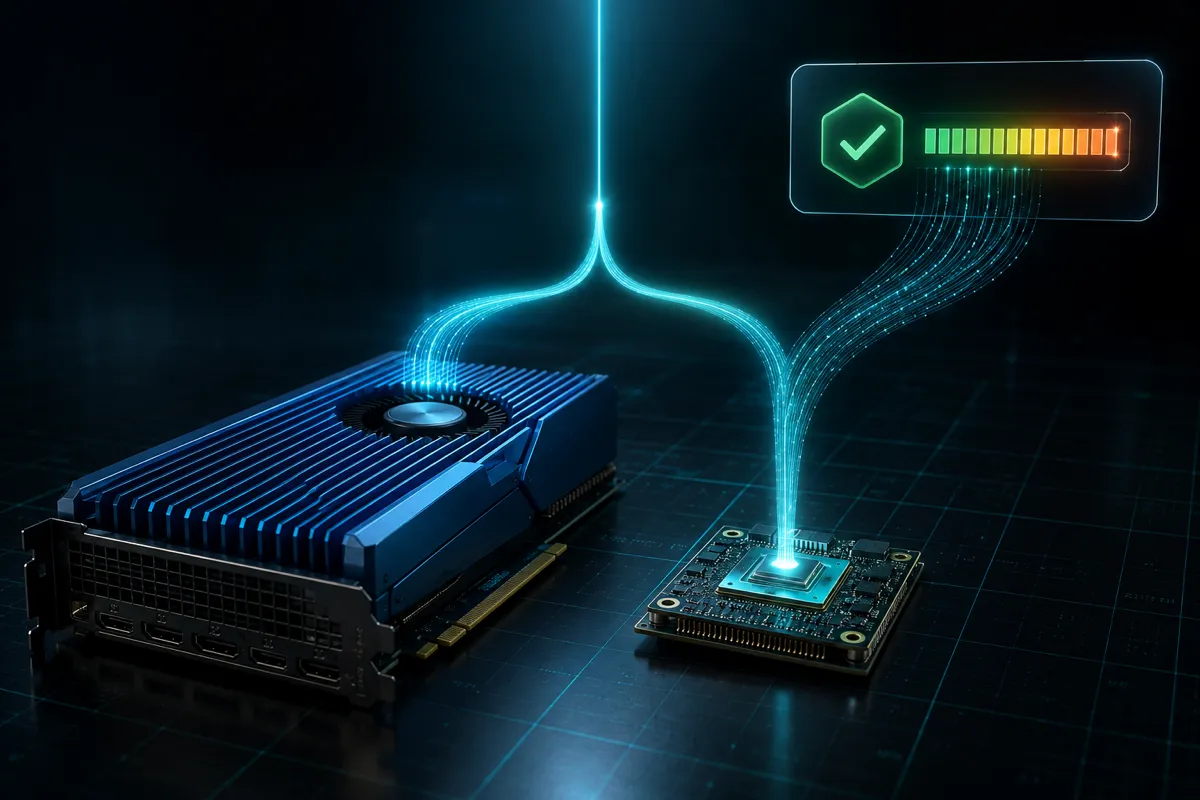
Does your trained model transfer to production data? Validate before you ship — not after it fails.

Sensor pair comparison
Two radars, two lidars, two cameras observing the same scene — do they structurally agree, or has one drifted?

Temporal drift detection
Has your data distribution shifted between last quarter and today? Catch regime change before your model notices.

Sim-to-real transfer
Does your simulated training data structurally match real-world sensor readings? Validate the reality gap before deploying.

Sim-to-sim comparison
Two simulators, same environment — do they produce structurally equivalent training distributions?

Domain randomisation
Does your randomised sim actually span the real-world variation your robot will encounter? Structural coverage analysis.

LoRA adapter testing
Does a fine-tuned adapter transfer to new data? Validate adapter compatibility before deploying to a new domain.
What you get from a single API call
POST /v1/audit/transfer — submit two datasets, get a complete structural analysis.
Oracle Score
A single number (0–100%) measuring structural alignment between your training and deployment data. Low score = structural mismatch the model cannot recover from.
Verdict
PASS, CAUTION, or RED_FLAG. A machine-readable deployment decision based on oracle score, coverage, and anomaly density.
Coverage Analysis
What fraction of the training distribution does your deployment data actually reach? Uncovered regions = blind spots where the model is guessing.
Recommendations
Prioritised actions with evidence. HIGH / MEDIUM / LOW priority. Each recommendation includes the structural evidence that triggered it.
We extract internal representations and analyse per-layer. Faster, no inference needed. Deeper analysis with layer-band breakdown (syntax / knowledge / output).
You run inference locally and send us the output vectors. Your weights stay private. Still get the full SAFE / RED_FLAG / BAD_MODEL verdict.
VLMs and VLAs: the hidden transfer risk
Each component passes its own benchmark. But when they run together in production, the joint space is where transfer fails — and standard accuracy hides it completely.
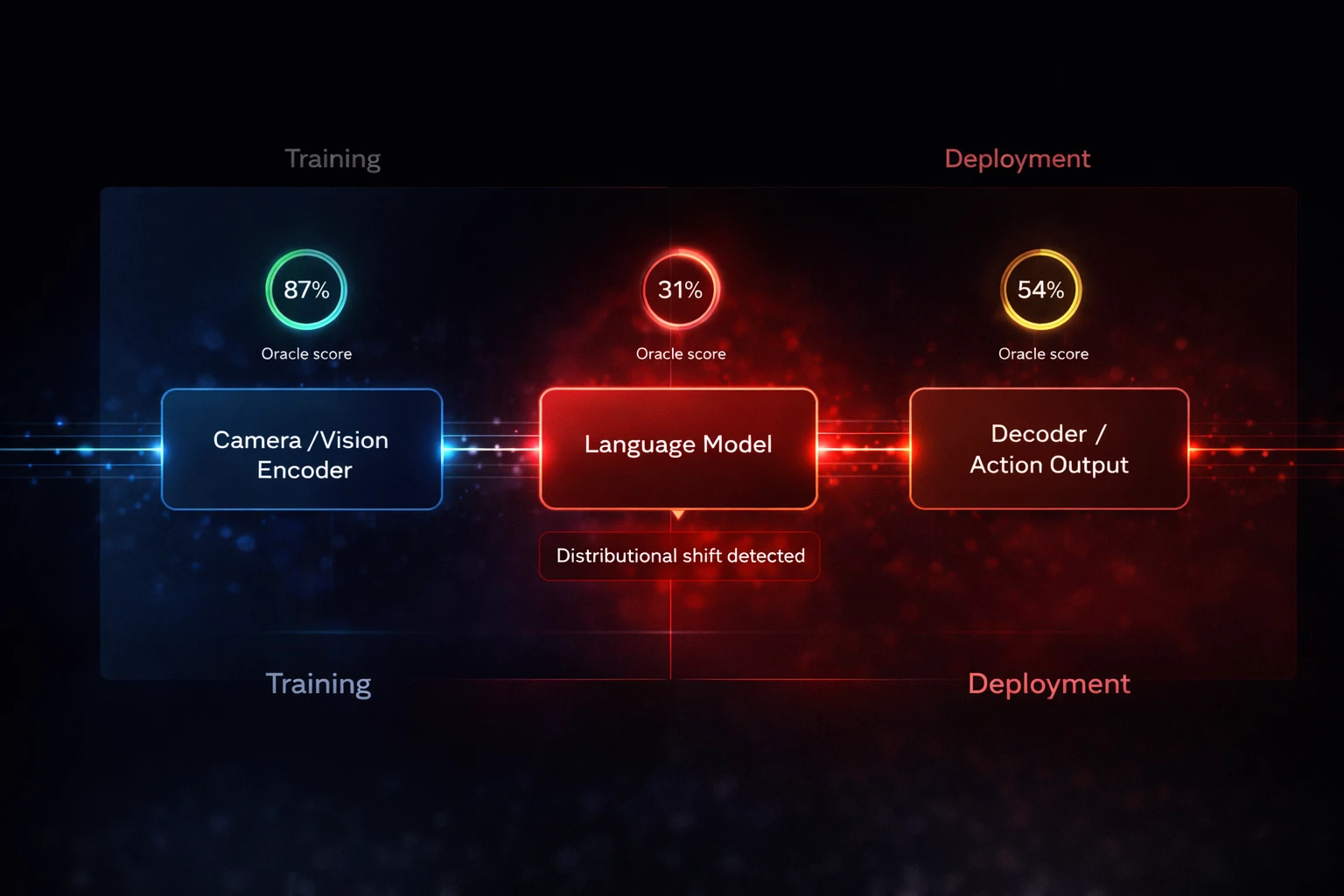
Vision space
Does the image encoder produce the same feature distribution on deployment data as it did during training? Scanner shift, lighting, and resolution all live here.
Text / language space
Does the language backbone handle deployment vocabulary, phrasing, and domain jargon the same way it handled training prompts?
Joint (fused) space
Even when vision and text individually look fine, the joint embedding can diverge. This is where cross-modal transfer breaks — and standard accuracy cannot detect it.
The numbers speak for themselves
Real benchmark results from MedMNIST datasets run through the Transfer Oracle API.
BloodMNIST: val vs oracle
96% published validation accuracy. 18% oracle score. Only 50% structural coverage. Standard metrics miss this.
PathMNIST → BloodMNIST
Half of deployment samples land in map regions with no training coverage — a silent failure waiting to happen.
Same domain (PathMNIST)
Same dataset, same domain — 100% coverage, 68% oracle. A healthy transfer baseline.
Transfer Oracle is Growt
At its core, Growt is a general mathematical framework for structural alignment. When two data sources observe the same underlying reality, their internal structures should agree. Growt measures whether they do — and when they don't, it tells you exactly where and how much.
AI model auditing is the most visible application, but the framework applies anywhere you need to compare two distributions structurally: sensor calibration, clinical trial equivalence, simulator validation, temporal drift detection. The mathematics are the same.
“Every existing tool tells you two datasets differ.”
“Transfer Oracle tells you how — which regions, which dimensions, how much coverage is at risk.”
Pre-deployment, not post-incident.
From cloud to silicon
Five deployment tiers. Same structural analysis. Choose the level of integration your use case demands.
Cloud
SaaS API
Send embeddings, get a structural audit report. Pay per call. Zero infrastructure.
Any model, any size
Notebook
On your GPU
For models too large for API payloads. Run the audit on your own GPU alongside extraction. We never see your model.
Large foundation models (40B+)
Edge
FPGA co-processor
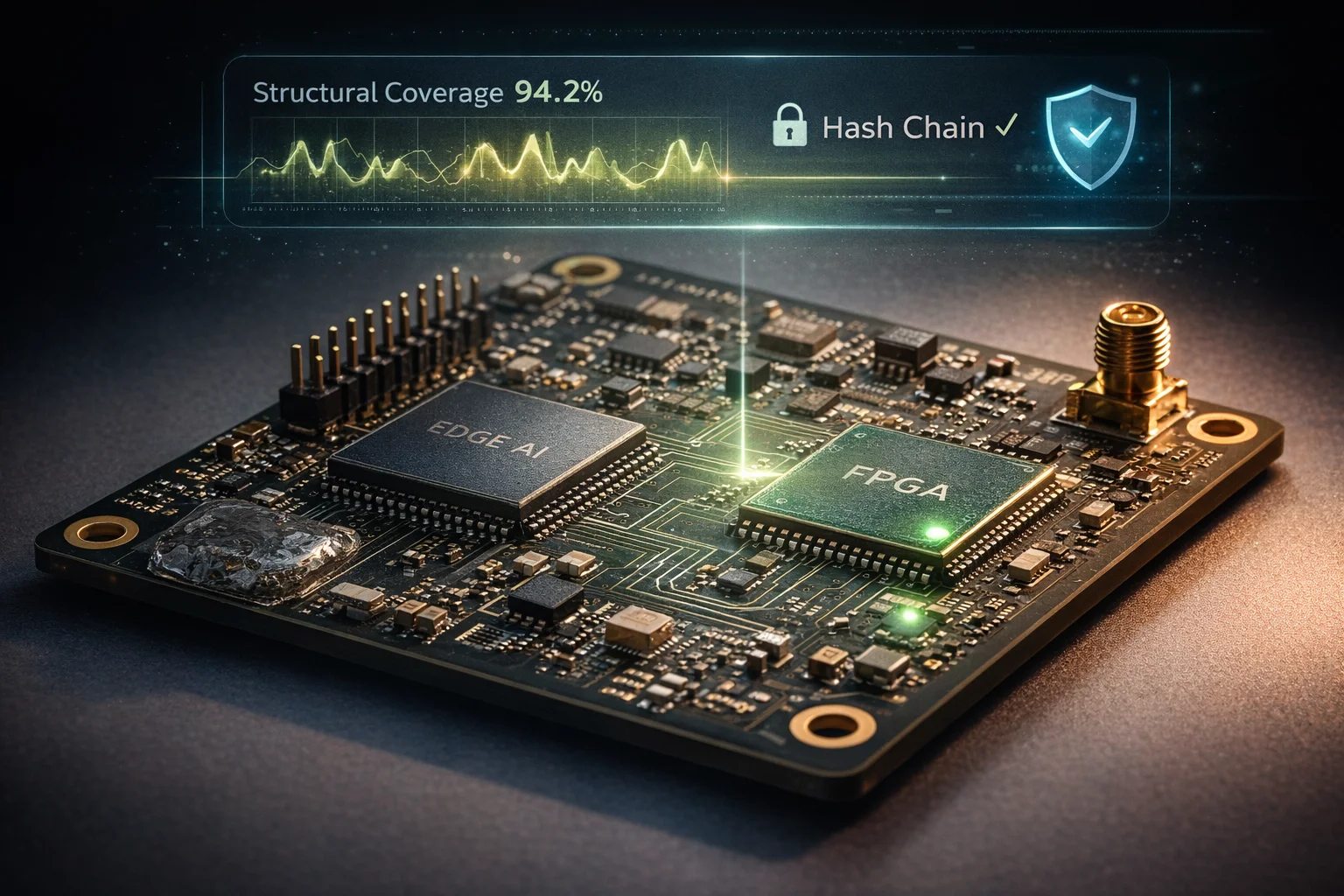
Hardware board monitors every inference in under 10 microseconds. Tamper-proof hash-chain audit trail.
Deployed models in production
Integrated
Model + audit on one chip
Your model and our audit run on the same SoC. Zero-latency. Your model stays private. Our methods stay private.
High-security edge deployment
Autonomous
Offline, tamper-proof
Same chip, no cloud required. Hardware-enforced monitoring with blockchain-anchored evidence. Insurable.
Military, medical, automotive
Talk to the Transfer Oracle agent
Describe your use case. The agent will run a demo audit, check whether your domain is covered, and help you get started.
Sign in to chat with the Transfer Oracle agent.
Sign inGet started in 2 minutes
No account required for your first audit.
Install the MCP tool
uvx mcp-growt-audit or npx -y mcp-growt-audit — adds Transfer Oracle tools to your AI agent.
Run a demo audit
Ask your AI agent: "Run a demo audit". It generates a synthetic RED_FLAG scenario so you can see the output format.
Audit your own models
Point audit_from_files at your .npy, .npz, or .csv embeddings. Or use audit_from_huggingface with a model ID.
Free API access — open to everyone
Transfer Oracle is free to use on our existing servers. Sign up below, receive a magic link to your inbox, and we’ll email you a personal API key — good for 30 days, renewable. Need more capacity? Contact us and we’ll see what we can expand the servers to fit your workload.
Paid plans are not yet live. The waitlist below is the only way to get a key right now.
Free
Try it out
1,000 / month credits
- 1,000 API credits
- Core audit endpoint
- Open-source plugins
- GitHub support
Join the waitlist
Enter your email. We’ll send a magic sign-in link, then email your personal API key.
All purchases require acceptance of our Terms of Service and Data Processing Agreement
Want to resell Transfer Oracle under your own brand? Become an operator →
Apply for access
Tell us about your use case. Your operator will review your application and get back to you.
Contact us
Have a question? Want to discuss your use case? Send us a message and we'll get back to you.
Operator Referral Programme
Recruit a new operator — earn based on their results. When you bring a new operator into the Growt network, you earn a performance bonus tied to their activity. The better they do, the better the bonus for you.
Organisation performance bonuses. There are also bonuses based on how your operator organisation as a whole performs — total revenue, growth, and customer outcomes. The network rewards collective success.
Were you referred by someone?
If an existing operator or contact brought you here, enter their details below so they receive credit for the referral.